
Working shifts in Saudi Arabia: staying close to family back home
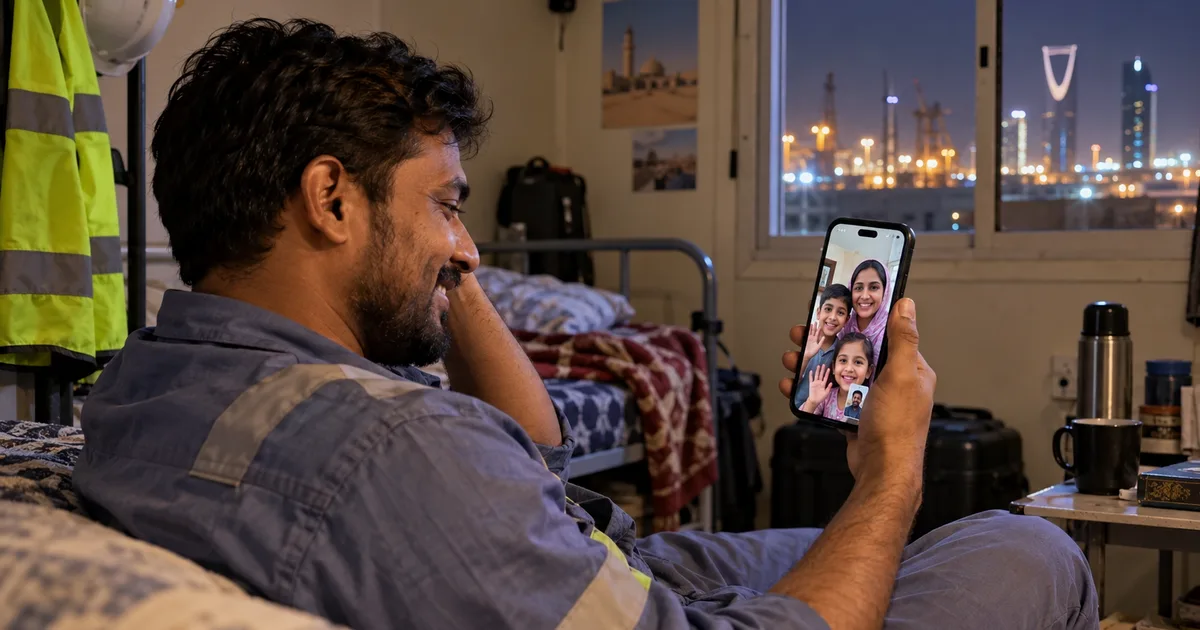
Millions of people from Pakistan, India and Bangladesh work in Saudi Arabia, many of them on sites, in camps or in jobs with twelve-hour shifts. The money goes home every month. The call home should too, and it is harder than it looks: by the time the shift ends, the family may be asleep, and the accommodation Wi-Fi is slowest exactly when everyone tries to call at once. This is how families make it work.
Know the gap
Saudi Arabia is on UTC+3. Pakistan is two hours ahead, India two and a half, Bangladesh three. A shift that ends at 8 p.m. in Riyadh is 10 p.m. in Lahore, 10.30 p.m. in Kerala and 11 p.m. in Dhaka. That is late for parents and children, so the evening call does not always fit. Mornings are often better: 7 a.m. before a shift is 9, 9.30 or 10 a.m. at home, when everyone is up.
Make one call the anchor
Pick one call in the week that never moves. For most families that is Friday, before or after prayers, when both sides are free. Make it a video call, put the phone on the table so the whole house is in it, and let it run long. On Connect Me Call you can add more relatives during the call to make it a group call, so a brother in Dubai or a sister in Karachi joins the same screen.
Everything else in the week can be short and flexible. One anchor call is easier to keep than five promises.
Use voice notes for the days the call cannot happen
The most useful feature for a shift worker is not the call. It is the voice note. Hold the microphone, say what you need to say, let go. It arrives now, and your mother listens when she wakes up and replies the same way. Over a week, a chain of voice notes and photos keeps a family closer than one rushed call at midnight.
Show your family how to send them before you leave, or over the phone with our guide to setting the app up for parents.
Beat the nine o'clock Wi-Fi
Shared Wi-Fi in accommodation is fine at 6 a.m. and crawls at 9 p.m. Three habits help:
- Voice first. A voice call uses well under 1 MB a minute and survives a weak connection far better than video.
- Camera off, then on. If the video freezes, switch the camera off; the call stays connected, and you can switch it back on when the signal improves.
- Call before the rush. If your shift allows, call at 7 or 8 p.m. local time, before the whole camp is online.
If you use mobile data instead, a video call can use 5 to 15 MB a minute depending on quality, so keep long video calls for Wi-Fi. Our guide to call data use has the numbers.
Let the family answer for free
On Connect Me Call only the person who starts the call uses minutes from their pack. If you make the calls, your parents never need to buy anything or think about minutes; they answer, and that is all. A call that drops on a weak signal does not use your minutes either, so a bad connection costs nothing but patience.
Keep your account safe through changes
Numbers change, phones get lost, contracts end and start. Your account follows your mobile number, so sign in on your new SIM when you have one; if the number changes, the app can move your account without losing your chats. Back up your chats, and your history comes with you to the next phone.
Small things that keep a family close
- A photo of your room, your workplace, your meal. It answers the question "how are you really" better than words.
- A short status, a picture or a line that disappears after a day, so the family sees you are fine even on days with no call.
- Your location, shared once, so your mother can see on a map where you are.
For the details of your route, see our pages on calling Pakistan from Saudi Arabia, India from Saudi Arabia and Bangladesh from Saudi Arabia.
Download the app
Free voice and video calls, group calls and chat with the people who matter, wherever they are.